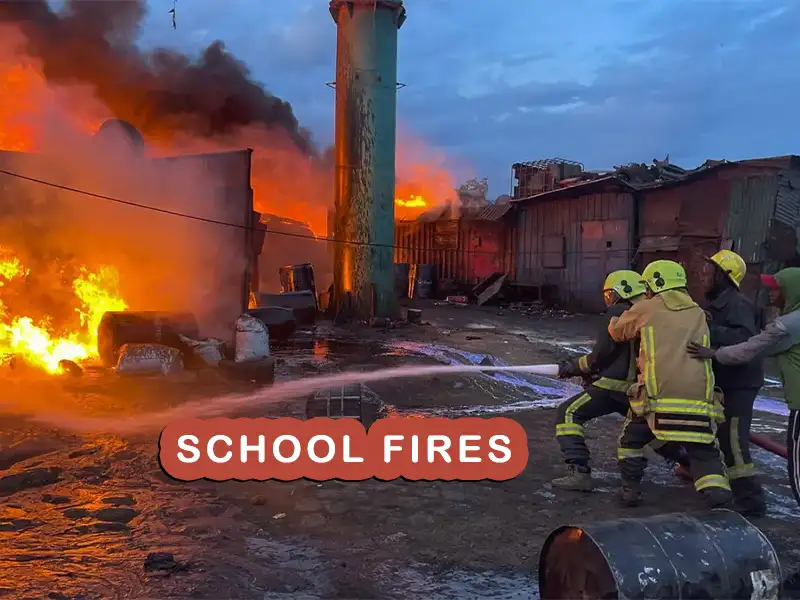
The ongoing school burning crisis in Kenya is raising eyebrows even as parents and other stakeholders decry grave losses amounting to millions in arson related damages. While school fires linked to student unrest have periodically occurred across for decades, the frequency and scale of incidents have become increasingly alarming.
The fire crisis extends beyond the immediate loss of buildings and equipment. It affects students, parents, teachers, and taxpayers who ultimately bear the burden of reconstruction costs. A recent incident of Utumishi Girls Academy is by far the most tragic after 16 learners were consumed by fire.
Why the school burning crisis is escalating
Ongoing investigations by government agencies and security authorities indicate that most incidents involve dormitories, which are often targeted at night when students can evacuate quickly.
In other cases, classrooms, laboratories, libraries, and administration blocks have been destroyed. The pattern suggests that school burning has evolved into a form of protest or expression of dissatisfaction among some learners.
List of most affected schools
- Utumishi Girls Academy
- Kisii High
- Chianda High
- Alliance High School
- Lang’ata High School
- Euro Ekulet Secondary
- St Paul’s Githakwa Secondary
- Nyabisase High School
Even more secondary schools have been torched and others closed indefinitely.
Besides indiscipline rampant cases of mental health, school management, examination pressure, and the overall welfare of learners are potential causes.
Reasons why students resort to arson
Although each case is unique, preliminary findings point to several common triggers:
- Overly strict disciplinary measures
- Academic pressure and examination anxiety
- Student grievances against school administration
- Peer influence and group behavior
- Poor communication channels within schools
- Mental and emotional stress among learners
In many instances, students feel that their concerns are ignored, leading some to engage in destructive acts as a means of retaliation.
Unfortunately, such actions often produce consequences far greater than the grievances that sparked them.
The extent of damages suffered so far
One of the most visible impacts of school arson is the destruction of infrastructure, mostly reduced to ashes within minutes.
Modern school buildings containing expensive installations, including electrical systems, furniture, laboratory equipment, computers, and learning materials are the most affected.
Elsewhere, school fires frequently destroy valuable educational resources. Books, examination records, laboratory apparatus, computers, and student projects.
These losses are expected to directly affect academic performance because students may lack access to essential learning materials during the recovery period.
Teachers will as well have to adjust their lesson plans and teaching schedules to accommodate disruptions.
Social and psychological consequences
Students are among the greatest victims of school burnings. Even those not involved in the incidents experience emotional distress, uncertainty, and disruption to their studies.
Some learners have lost personal belongings such as clothing, books, certificates, and electronic devices.
Others are struggling with anxiety after witnessing a traumatic fire event within their school environment.
On the other hand, teachers and school heads are facing intense pressure in managing investigations, reassuring parents, and coordinate recovery efforts.
Erosion of public confidence
Frequent school burnings have weakened public confidence in the most affected institutions.
Parents are now questioning the safety of boarding schools and the community is concerned about the effectiveness of disciplinary systems.
What next after school burnings?
Schools have been urged to invest more resources in professional counseling services.
Early identification of emotional and behavioral challenges among learners can go a long way in helping prevent situations from escalating into acts of destruction.
Even so, creating structured platforms where students can express concerns and contribute ideas may reduce feelings of exclusion considering that open dialogue encourages trust and promotes peaceful problem-solving.
Institutions should as well strengthen fire prevention systems, install modern detection equipment, conduct regular safety drills, and establish clear emergency response procedures.
Above all, creating a supportive school environment built on respect, communication, and mutual understanding can significantly reduce tensions. Strong relationships between students and staff create opportunities for early intervention when problems arise.
In conclusion, parents, teachers, government agencies, religious organizations, and community leaders all have roles to play in addressing the crisis. Sustainable solutions require coordinated efforts that focus on both prevention and response.

Bsc. Mechatronics engineer & founder of Rejnac Group Inc. with a strong passion for Robotics, networking, ICT, digital marketing, and AI applications. My goal in this web project is to highlight educational trends that are re-shaping your skills and career path.